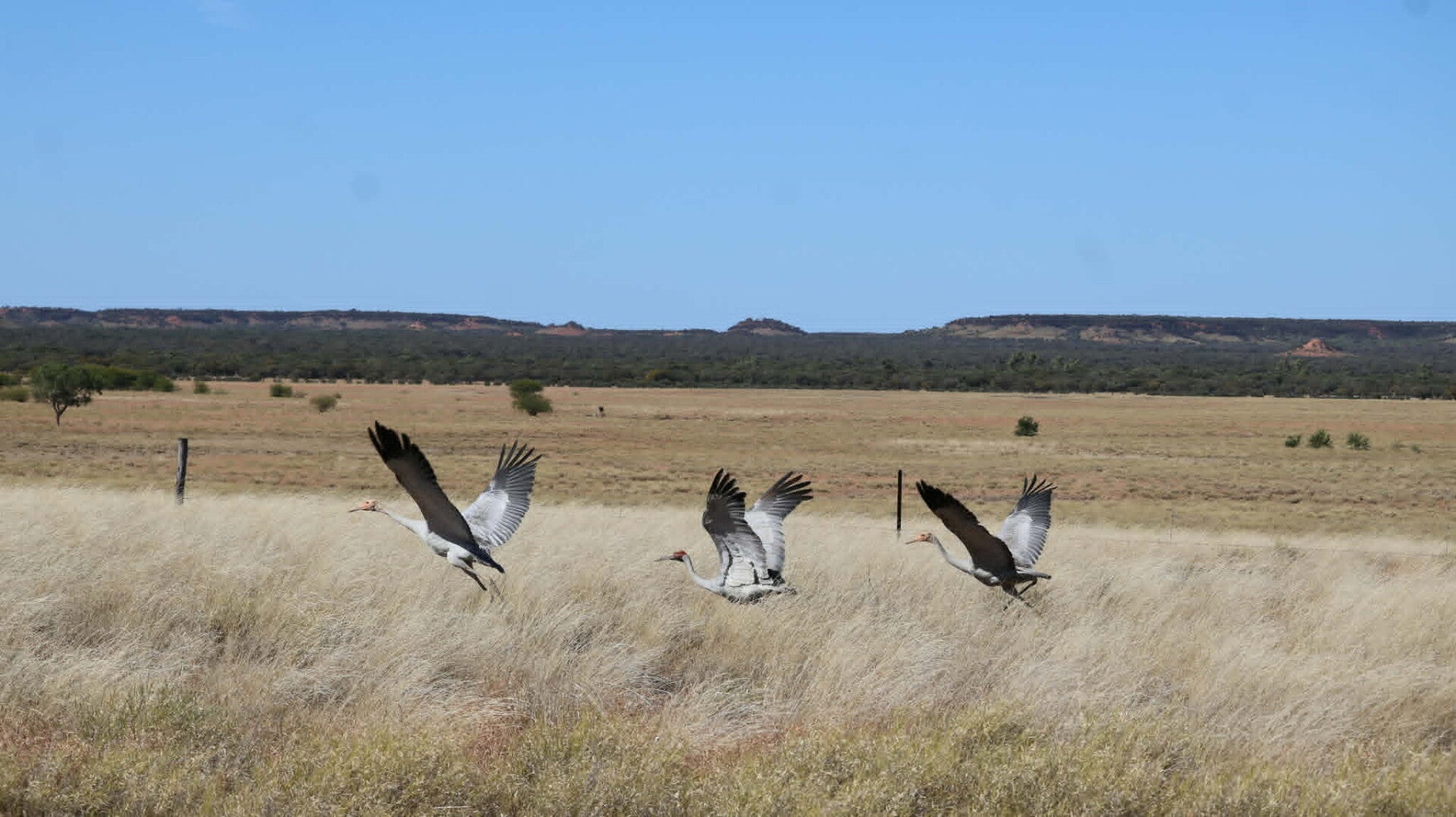
From Longreach, we traversed vast Mitchell grass plains stretching endlessly to the horizon. After recent rains, the landscape was lush and thriving, with some properties even baling the abundant grass — something we’re told isn’t uncommon in a good year out here.
Rolling into Winton, we were immediately struck by the warm, welcoming feel of a true country town. Home to around 850 residents, Winton is built on sheep and cattle farming and proudly wears its titles as the “Dinosaur Capital of Australia” and the birthplace of Banjo Paterson’s iconic bush ballad, Waltzing Matilda.
After topping up our water tanks, we made our way just 4.5 kilometer's out of town to Long Waterhole — an absolute gem. This free camp, provided by the Winton Shire, sits beside a stunning waterhole teeming with wildlife. Not long after setting up, we were greeted by two elegant brolgas wandering past our campsite — a pretty special welcome.
During our stay, we explored the town and its attractions. While Winton is home to the Waltzing Matilda Centre, we chose to save our pennies for a visit to the Australian Age of Dinosaurs — a decision we’re glad we made.
Winton also lies at the heart of Australia’s boulder opal country. Opal was first discovered here in 1888, sparking a mining boom and leading to the establishment of nearby Opalton, about 123 kilometer's southwest. Today, the region still attracts fossickers, and Winton offers plenty of opportunities to learn more about these unique gems.
In the center of town stands the striking art deco North Gregory Hotel — a building with a story as rich as the landscape. Originally built in the late 1800s, the hotel has been destroyed by fire three times (in 1899, 1916, and 1946) and rebuilt each time. The current structure, opened in 1955, remains a proud and iconic feature of Winton.
The highlight of our time here was undoubtedly our visit to the Australian Age of Dinosaurs, located 24 kilometers southeast of town atop a striking mesa known locally as a “jump-up.” This world-renowned museum houses the largest collection of Australian dinosaur fossils, dating back 95–100 million years.
We opted for the full three-tour experience, and it did not disappoint. First, we explored the Fossil Preparation Laboratory — the most productive of its kind in the Southern Hemisphere — where we watched fossils being carefully uncovered and even got to touch a real dinosaur bone.
Next, we boarded the Noble Express to the Dinosaur Canyon Outpost for the “March of the Titanosaurs” exhibition. Here, our guide explained how a remarkable 54-metre-long tracksite had been relocated to the Jump-Up. Seeing these ancient footprints — left by massive sauropods 95 million years ago — was incredible and easily one of the best examples in Australia.
We then wandered through the outdoor canyon exhibition, where life-sized bronze dinosaurs and flying reptiles are set among prehistoric plants, giving a vivid sense of what this land once looked like.
Our final stop was the Collection Room, where we watched a presentation surrounded by the only known fossil specimens of Australovenator (Banjo), Diamantinasaurus (Matilda), and Savannasaurus (Wade). At $78 per person, the full experience was exceptional value and a definite must-do.
We capped off the day with a classic pub meal before returning to camp for one last breathtaking sunset over the waterhole. There’s something truly special about watching the birds settle in as the sky fades to reveal a blanket of stars.
Leaving Winton, our next stop was the sign marking the beginning of the Outback Way — affectionately known as “Australia’s longest shortcut.” Stretching 2,700 kilometer's from Winton in Queensland to Laverton in Western Australia, this is an adventure we’d been eagerly anticipating.
Travelling along the now-sealed Kennedy Development Road, we crossed wide-open plains and rugged “jump-up” country before stopping at Cawnpore Lookout. A short walk rewarded us with sweeping panoramic views across the surrounding ranges and plains.
Our next stop was the Middleton Hotel — one of Queensland’s most isolated pubs and the only remaining structure of what was once a small township. Established in 1876, it served as a Cobb & Co. staging post until 1915. Today, it stands alone, rich in history and character.
As we continued toward Boulia, we passed signs warning of encounters with the mysterious Min Min Light — a phenomenon that has intrigued travellers for generations.
Crossing the Burke River, we rolled into Boulia — a small but significant outback town with a population of around 600, spread across an enormous shire. With its wide streets, simple homes, and rugged surroundings, it’s clear life out here can be tough.
We set up camp just outside of town along the Burke River near the racecourse — a peaceful spot complete with stunning sunsets and a surprising highlight: camels. Locally owned, they roam freely and are part of the town’s identity, especially during the famous Boulia Camel Races held each July. Friendly and curious, they made for a memorable experience.
In town, we visited the Min Min Encounter — an interactive attraction that brings the legend of the Min Min Lights to life through storytelling and clever technology. It was fascinating and offered a range of theories, though none fully explain the phenomenon.
We also explored the Boulia Heritage Complex, which captures three distinct chapters of the region’s history: prehistoric marine life, First Nations culture, and pioneer settlement. From ancient sea reptiles like ichthyosaurs and plesiosaurs to the stories of the Pitta Pitta people and early settlers, it offers a compelling glimpse into the past.
Another significant site is the Corroboree Tree — a rare Wadi (Acacia Peuce) tree located behind the Boulia State School. As the last recognised corroboree tree of the Pitta Pitta people, it holds deep cultural significance and stands as a reminder of the area’s rich Indigenous heritage.
We loved our time in Boulia. It’s a place defined by red dirt, resilience, and a strong sense of community — where life moves at a slower pace and the connection to the land runs deep.
From here, we hit the Plenty Highway… and it’s safe to say things are about to get seriously Unshackled.
** Tip: For the best viewing experience, click the YouTube link in the bottom left corner of the video to watch in higher clarity.
Add comment
Comments